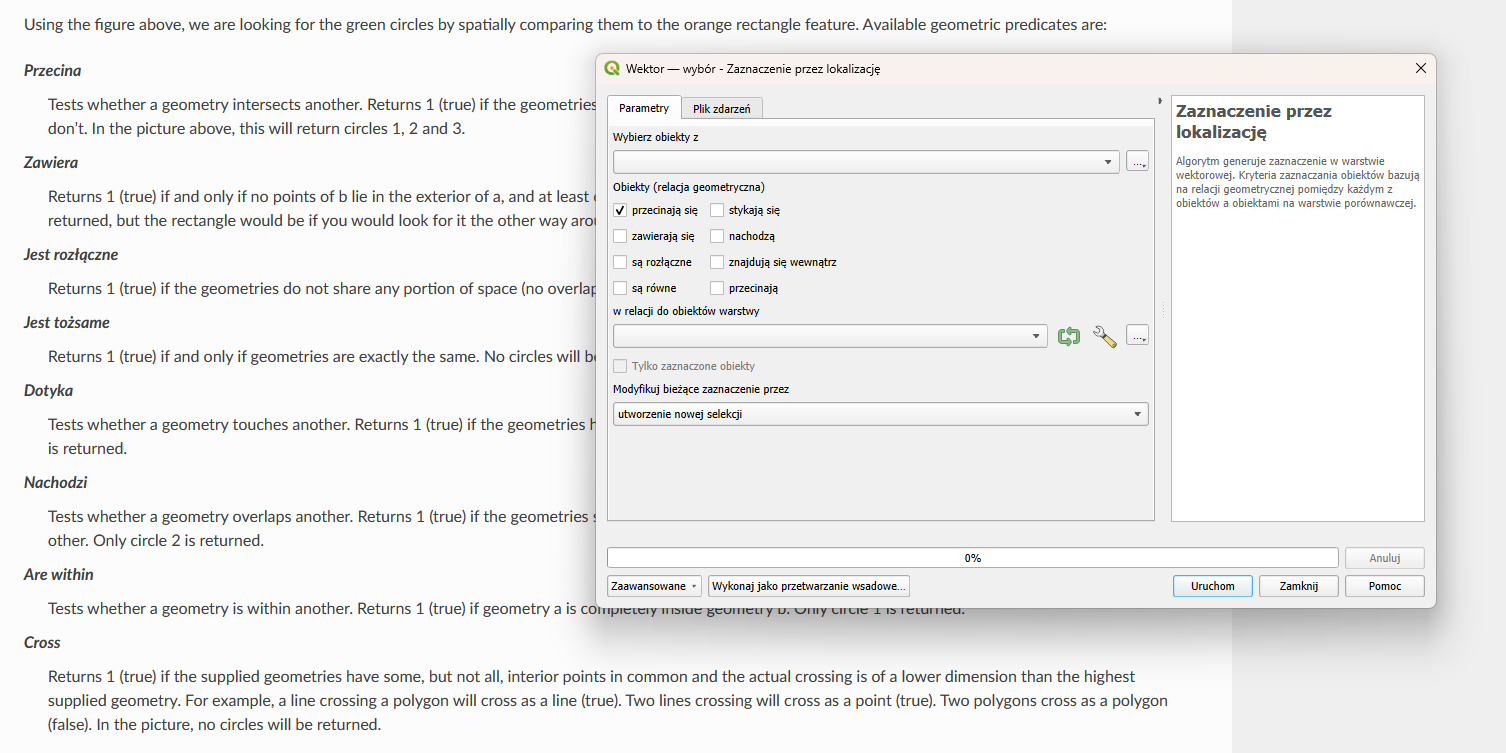
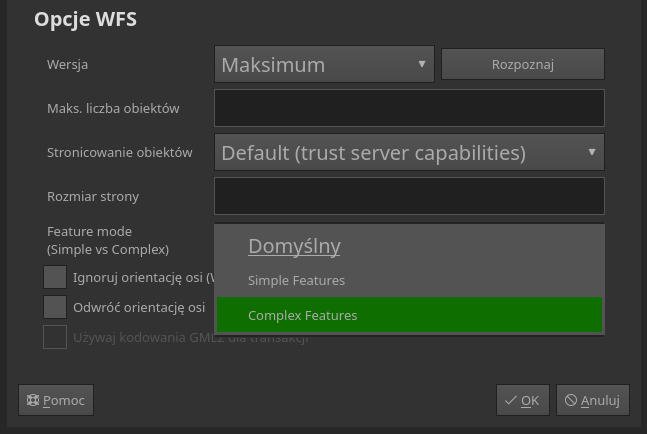
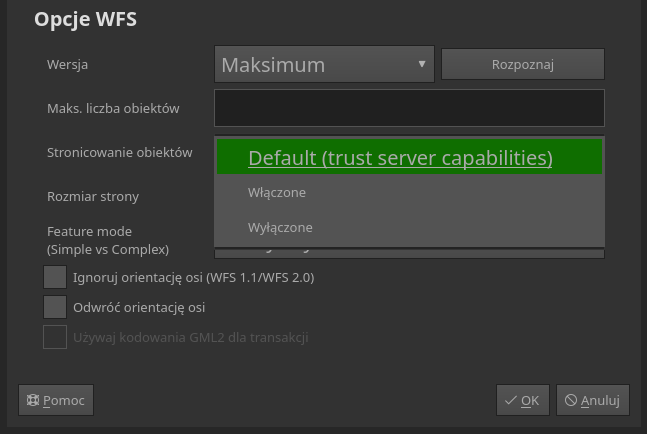
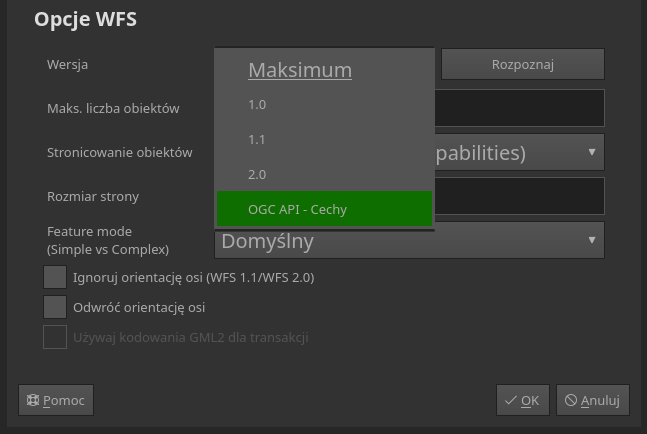
To ja jeszcze dodam kilka propozycji z brzegu:
1. Funkcja Azymut
 Błąd gramatyczny („argumenty” zamiast „argumentów”).
 Poprawnie: „Funkcja azimuth wymaga dwóch punktów jako argumentów.”
<message>
    <location filename="../src/core/expression/qgsexpressionfunction.cpp" line="5538"/>
    <source>Function `azimuth` requires two points as arguments.</source>
    <translation>Funkcja `azimuth` wymaga 2 punktów jako argumenty.</translation>
</message>
2. Kanały rastra
Błąd merytoryczny. W tym kontekście chodzi o numer jednego kanału (band), nie ich liczbę.
Poprawnie: „Numer kanału”
<message>
    <location filename="../src/analysis/processing/qgsalgorithmrasterlayerproperties.cpp" line="65"/>
    <source>Number of bands in raster</source>
    <translation>Liczba kanałów rastra</translation>
</message>
3. Przypis vs Adnotacja
 W kontekście QGIS chodzi o adnotację (np. etykieta na mapie), nie przypis tekstowy.
Poprawnie: „Adnotacja”
<message>
    <location filename="../src/core/layout/qgslayoutitemmap.cpp" line="1534"/>
    <location filename="../src/core/layout/qgslayoutitemmap.cpp" line="1536"/>
    <source>Annotations</source>
    <translation>Przypisy</translation>
</message>
oraz
<message>
    <location filename="../src/gui/processing/qgsprocessingwidgetwrapperimpl.cpp" line="7338"/>
    <source>Annotation</source>
    <translation>Przypis</translation>
</message>
5. Gemetria
Literówka w słowie „gemetria”.
Poprawnie: „geometria liniowa/wieloliniowa”
<message>
    <source>a LineString/MultiLineString geometry</source>
    <translation>gemetria liniowa/wieloliniowa</translation>
</message>
6. Vector overlay przetłumaczona jako „Wektor — algebra mapowa”
Błąd merytoryczny. „Overlay” w QGIS oznacza operacje nakładania warstw (union, intersect, difference).
Poprawnie: „Operacje nakładania wektorów” lub „Nakładanie warstw wektorowych”.
<message>
    <location filename="../src/analysis/processing/qgsalgorithmclip.cpp" line="49"/>
    <location filename="../src/analysis/processing/qgsalgorithmdifference.cpp" line="41"/>
    <location filename="../src/analysis/processing/qgsalgorithmextractbyextent.cpp" line="39"/>
    <location filename="../src/analysis/processing/qgsalgorithmintersection.cpp" line="37"/>
    <location filename="../src/analysis/processing/qgsalgorithmlineintersection.cpp" line="41"/>
    <location filename="../src/analysis/processing/qgsalgorithmmultidifference.cpp" line="43"/>
    <location filename="../src/analysis/processing/qgsalgorithmmultiintersection.cpp" line="43"/>
    <location filename="../src/analysis/processing/qgsalgorithmmultiunion.cpp" line="43"/>
    <location filename="../src/analysis/processing/qgsalgorithmsplitwithlines.cpp" line="42"/>
    <location filename="../src/analysis/processing/qgsalgorithmsymmetricaldifference.cpp" line="39"/>
    <location filename="../src/analysis/processing/qgsalgorithmunion.cpp" line="35"/>
    <source>Vector overlay</source>
    <translation>Wektor — algebra mapowa</translation>
</message>
7. Dissolve result przetłumaczone jako Agreguj wyniki
Myli pojęcia: „dissolve” nie oznacza „agregacji”, lecz scalenie obiektów o wspólnych atrybutach.
Poprawnie: „Scal wynik” lub „Scal obiekty wynikowe”.
<message>
    <location filename="../src/analysis/processing/qgsalgorithmbuffer.cpp" line="65"/>
    <source>Dissolve result</source>
    <translation>Agreguj wyniki</translation>
</message>
oraz
<message>
    <source>Dissolve result</source>
    <translation>Agreguj wyniki</translation>
</message>
8. Keep disjoint results separate przetłumaczone jako „Rozłączne obiekty pozostaw jako oddzielne”
Niezgrabna składnia.
Poprawnie: „Pozostaw rozłączne obiekty jako osobne elementy”.
<message>
    <location filename="../src/analysis/processing/qgsalgorithmbuffer.cpp" line="67"/>
    <source>Keep disjoint results separate</source>
    <translation>Rozłączne obiekty pozostaw jako oddzielne</translation>
</message>
9. Buffer distance przetłumaczone jako „Odległość bufora”
Niepoprawne w znaczeniu — bufor ma promień, nie „odległość”.
Poprawnie: „Promień bufora” lub „Szerokość bufora”.
<message>
    <source>Buffer distance in map units</source>
    <extracomment>v.buffer</extracomment>
    <translation>Odległość bufora w jednostkach mapy</translation>
</message>
oraz
<message>
    <source>buffer distance in layer units</source>
    <translation>odległość bufora w jednostkach warstwy</translation>
</message>
oraz
<message>
    <source>buffer distance. Positive values will be buffered to the left of lines, negative values to the right</source>
    <translation>odległość bufora; dodatnie wartości będą buforowane po lewej stronie linii, ujemne natomiast po prawej stronie linii</translation>
</message>
10. Clip vector by extent przetłumaczone jako „Przytnij wektor do zasięgu”
Niezręczne – „wektor” to skrót myślowy, chodzi o warstwę wektorową.
Poprawnie: „Przytnij warstwę wektorową do zasięgu”.
<message>
    <source>Clip vector by extent</source>
    <translation>Przytnij wektor do zasięgu</translation>
</message>
i na deser : 10 Buffer jako otoczka
Niekonsekwentne i wprowadzające w błąd - Bufor jako produkt analizy występuje w wielu innych miejscach i jako taki powinien pozostać.
Lepsze tłumaczenie - po prostu: „Bufor”.
<message>
    <location filename="../src/ui/qgsoptionsbase.ui"/>
    <source>Buffer</source>
    <translation>Otoczka</translation>
</message>
oraz
<message>
    <location filename="../src/ui/labeling/qgslabelpropertydialogbase.ui"/>
    <source>Buffer</source>
    <translation>otoczka</translation>
</message>

 .
.